


Why You Can't Sleep: The Truth About Sleep Anxiety (And Why Nothing Has Worked)

You've Done Everything Right
You've ticked off the sleep hygiene checklist. No screens after 8pm. Magnesium on the bedside table. Lavender spray on the pillow. You've downloaded the meditation app, bought the weighted blanket, cut out caffeine after midday. You've seen your doctor, maybe a naturopath. Someone probably suggested chamomile tea.
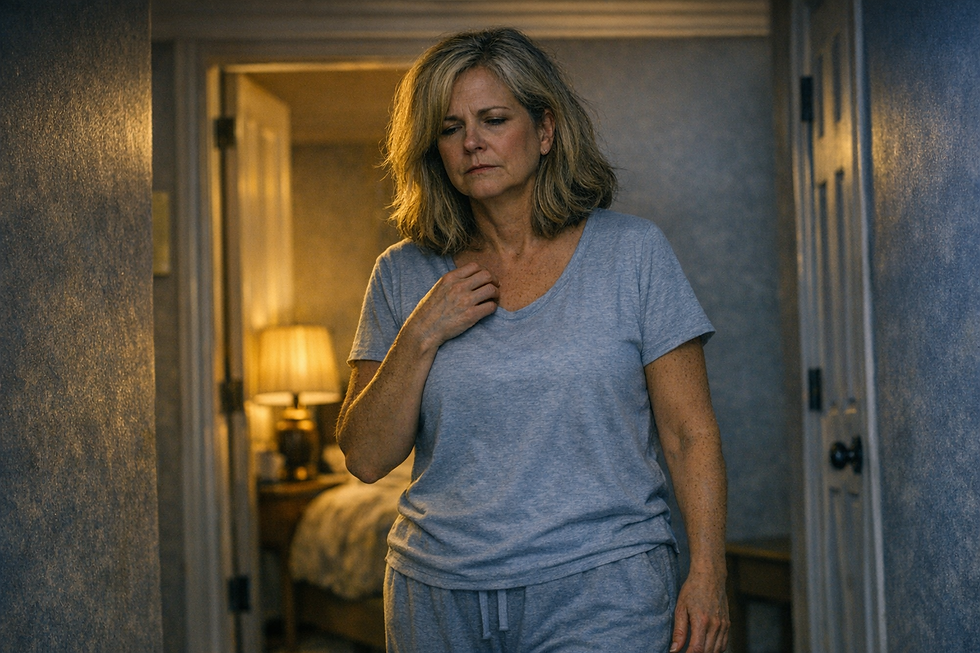
And still, at 2am, you're lying there wide awake — mind racing, body tense, watching the clock with a familiar sense of doom. And somewhere underneath the exhaustion, a quiet anxiety has taken hold — about tonight, about tomorrow, about whether this will ever change.
Here's what I want you to know before we go any further: you are not broken. You are not failing at sleep. And this is not a willpower problem.
What you're dealing with has a name. And once you understand what's actually happening, everything starts to make sense.
How Do You Know It's Sleep Anxiety?
Sleep anxiety doesn't always look like fear or dread. It can be quieter than that — and in some ways harder to name. It might show up as doubt, wariness or questions about whether sleep will come. Thoughts that begin to repeat — 'I can't sleep', 'my mind won't switch off', 'why can't I just relax' — until they become ingrained beliefs: 'I'm a bad sleeper', 'my mind and body are working against me', 'this is just how I am now.' A loss of faith in your body that builds slowly, almost without you noticing. And the longer it goes on, the darker it can get — frustration, anger, despair, a creeping hopelessness that this will ever change.
Read through these and notice how many feel familiar:
You dread bedtime — or you simply brace for it. Not dramatically, just a quiet resignation that settles in through the late afternoon.
You watch the clock. You do the maths. If I fall asleep now, I'll get six hours. Five and a half. Five. Each calculation makes it harder to drift off.
You catastrophise about tomorrow. You lie there thinking about everything you have to do, the meeting you need to be sharp for, the children you need to show up for — and your mind convinces you that without sleep, you'll fail all of it. Every unresolved worry surfaces, louder and more catastrophic than it felt in daylight.
You feel wired but exhausted at the same time. Your body is bone‑tired. Your mind won't stop. You can feel the low hum of alertness keeping you suspended just above sleep.
You've lost faith in your body's ability to sleep. What once happened automatically now feels uncertain, unpredictable, out of your hands.
You make all sorts of excuses as to why you haven’t slept/well. You're quick to blame anything that might have disturbed you, knowing deep down it’s all on you.
You feel a kind of hopelessness about it. You've tried so much. Nothing has worked. You're not even sure anything can.
You are sensitive to the topic. If anyone innocently asks about your sleep, you wish they wouldn't. You try to ignore it or play it down and struggle not to snap at them.
You may feel fine when the pressure is off. Sleep may be easier on holidays, or on nights with less pressure the next day, or even anywhere else in the house that isn't your bed. This is significant — it means sleep is still in there. It's the uncertainty and pressure around sleep that's the problem, not sleep itself.
If you read through that list and saw yourself within it — this is for you.
What you're experiencing is not a character flaw or a sign that something is fundamentally wrong with you. It is a very specific pattern that develops when the nervous system starts treating sleep as something uncertain and unsafe — something you might not be able to do. It is more common than you might think and can affect anyone at any stage of their life. You are not alone in this. And there is a reason it has felt so hard to fix.
You are not alone in this. And there is a reason it has felt so hard to fix.
This Isn't Just a Sleep Problem. It's Also an Anxiety Problem.
Most sleep advice is designed to address the conditions and patterns that support healthy sleep — a consistent schedule, a darker room, winding down properly. That advice can help, and for some people it's enough. But if anxiety about not sleeping is driving your sleeplessness, those strategies alone won't touch the root of it. Because the barrier to sleep isn't just behavioural — it's physiological. An activated nervous system running on stress hormones needs more than a better bedtime routine. That's where sleep anxiety comes in.
Sleep anxiety is what happens when the mind begins to associate sleep not with rest, but with uncertainty and threat.
Somewhere along the way — after a period of stress, illness, hormonal change, or a run of bad nights — your nervous system learned that sleep is unpredictable. Something uncertain. Something you might not be able to trust yourself to do.
And now every time you get into bed, your brain scans for danger. Will tonight be another bad night? What if I can't sleep again? I have so much on tomorrow.
That thought spiral triggers a stress response — cortisol, adrenaline, a body primed for action — which makes sleep physiologically impossible. Then the wakefulness confirms the doubt. Which makes tomorrow night feel even less certain.
This is the anxiety-about-not-sleeping loop. And it is relentless.
Why Traditional Sleep Advice Can Fall Short
Here's the cruel irony: most conventional sleep advice actively feeds the loop.
When someone tells you to "just relax," your nervous system hears: relaxing is a task you might fail at. When you download another sleep app and it doesn't work, the message your brain receives is: see, even this didn't fix you. Every effort you make to resolve it only seems to build more evidence that sleep is something you can't trust yourself to do. For some reason it feels out of reach — and you don't quite know why.
The supplements aren't doing nothing. The meditation isn't worthless. But they're being applied to the wrong problem. They address the conditions and patterns that support healthy sleep — and that side matters. But they don't directly reach the physiological activation that sleep anxiety creates. The nervous system stuck in a state of alert, the stress hormones running in the background, the body braced for another bad night — that needs its own direct attention. It's no use treating the symptom — wakefulness — when the root is anxiety and a body physiology that resists dropping into sleep.
The problem isn't that your body is broken. The problem is that it got the wrong information — and what it needs now isn't more behavioural strategies, but something that addresses the anxiety directly, in the body, at its source.
Four Truths About Sleep Anxiety
The first truth is that sleep anxiety is a specific pattern within the broader picture of insomnia. It's a learned association between sleep and threat — one that can develop alongside other contributors to poor sleep. And crucially, learned patterns can be unlearned.
The second truth is that your exhaustion is real — but not just from lack of sleep. It's from the battle — the nightly conflict between a body that desperately wants rest and a mind and nervous system that won't stand down. That level of sustained effort, night after night, is profoundly depleting.
The third truth is that your body already knows how to sleep. Sleep is not a skill you've lost — it's a natural process your nervous system has been blocking because it thinks it's protecting you.
The fourth truth is that this is solvable. Not managed, not white-knuckled through. Genuinely resolved. When the anxiety is addressed directly — the thoughts, the emotions, the beliefs, the physiological activation — the nervous system learns that sleep is safe again. The hypervigilance dissolves. Sleep returns — not because you forced it, but because you stopped blocking it.
I know what it feels like to lie awake night after night, losing faith that anything will ever change. I also know what it feels like when it does. If you're ready to understand what's really been driving your sleep struggle — and to finally address it at its source — you're in the right place.
Where Do You Go From Here
Understanding the loop is the first step. But insight alone doesn't rewire a nervous system. That takes something more specific — work that speaks directly to the body, not just the mind.
This is exactly what the Sleep Anxiety Reset © is designed to do. We address sleep anxiety on all fronts – in the body, the mind and the emotions…and that is how real change happens.
It primarily combines body-mind modality Emotional Freedom Techniques (EFT) aka ‘Tapping’, mentoring, and other somatic, behavioural and sleep approaches as needed to address sleep anxiety at the level where it actually lives — in the body's threat response, not in your habits or your hygiene routine.
For sleep deprived people who are ready to stop managing their sleeplessness and start resolving it, the 6 Week Sleep Anxiety Reset Programme © offers a structured, supported path through that process. Six weeks. Real shifts. A nervous system that finally learns bedtime is not a battlefield.
You've already tried the things that should have worked. This is something different.
Ready to Find Out If This Is Right for You?
If you recognise yourself in these pages — if you've felt that particular exhausted dread of facing another night without sleep — I'd love to talk.
Book a free discovery call and we'll look at what's driving your sleep anxiety and whether the programme is the right fit. No pressure, no pitch. Just clarity.
Sarah Bartlett is a sleep anxiety specialist with over 10 years of experience working with people navigating stress, anxiety, and burnout. She works with clients online and face-to-face, using EFT, mentoring, and other approaches as needed to help them resolve sleep anxiety at its root — not just manage the symptoms. She is the kind of person you wish you'd found years ago.

S


Comments